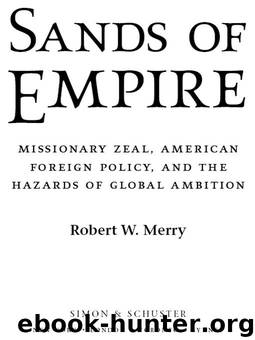
Sands of Empire by Robert W. Merry
Author:Robert W. Merry
Language: eng
Format: epub
Publisher: Simon & Schuster
Part III
An Era Born in Blood
Chapter 9
The Neoconservatives
JUST WEEKS BEFORE AMERICA’S invasion of Iraq in spring 2003, the country’s leading neoconservative journal, The Weekly Standard, published a cover article by the country’s most unabashed advocate of American imperialism, Max Boot. Called “The End of Appeasement: Bush’s Opportunity to Redeem America’s Past Failures in the Middle East,” it urged the United States to provide those Islamic lands with “effective imperial oversight.” The coming liberation of Baghdad, Boot suggested, could be one of those “hinge moments of history,” like the storming of the Bastille or the fall of the Berlin Wall—a pivotal point in time “when the powerful antibiotic known as democracy [would be] introduced into the diseased environment of the Middle East, and…transform the region for the better.”
The Boot argument reflected the emergence of a foreign policy outlook that combined the Will to Power imperialism of Theodore Roosevelt with the humanitarian impulse of Woodrow Wilson. This proved to be a powerful political potion after the 9/11 terrorist attacks on America, and it stirred George W. Bush to send his military halfway around the world to plant his nation’s flag into the heartland soil of Islam. He would do this while denying that his action, or the events that precipitated it, signified a clash of civilizations of the kind that Samuel Huntington had predicted. He would also deny any imperial intent.
Rather he would insist that his military initiative was aimed strictly at the scourge of terrorism, at those who pray to the “God of hate,” as Thomas Friedman had put it. A corollary conviction was that these worshippers of hate could not thrive where societies embraced the principles of Western democratic capitalism. And so he would introduce those principles into Iraq and perhaps other Middle Eastern lands as well, his administration suggested, as the most effective way of thwarting the threat of Islamic fundamentalist attacks on the West.
Subsequent events surrounding the U.S. Iraqi occupation exposed both the naïveté and the folly of that outlook. And, as these events unfolded, it was not surprising that national attention would turn to the neoconservatives whose thought and advocacy had proved so influential in crafting the governmental rationale for the war. A pressing area of inquiry became the philosophical etymology of the neoconservative resolve to remake the Middle East in the image of American democratic capitalism. The story begins by all accounts in the late 1930s in the City College of New York cafeteria’s Alcove No. 1. That’s where a small group of non-communist socialists—Irving Kristol, Seymour Martin Lipset, Nathan Glazer, Daniel Bell, and Melvin Lasky, among others—gathered daily to engage in fervent undergraduate debates over the nature of the world—and the distinctions between their worldview and that of the communists across the way in Alcove No. 2.
They graduated to careers as academics, pamphleteers, essayists, and editors of small but influential journals, along the way drawing to their New York circle other like-minded intellectuals, notably Norman Podhoretz, Midge Decter, and Gertrude Himmel-farb. In the early Cold
Download
This site does not store any files on its server. We only index and link to content provided by other sites. Please contact the content providers to delete copyright contents if any and email us, we'll remove relevant links or contents immediately.
| Elections & Political Process | Ideologies & Doctrines |
| International & World Politics | Political Science |
| Public Affairs & Policy | Specific Topics |
| United States |
The Secret History by Donna Tartt(19296)
The Social Justice Warrior Handbook by Lisa De Pasquale(12224)
Thirteen Reasons Why by Jay Asher(8998)
This Is How You Lose Her by Junot Diaz(6955)
Weapons of Math Destruction by Cathy O'Neil(6363)
Zero to One by Peter Thiel(5864)
Beartown by Fredrik Backman(5839)
The Myth of the Strong Leader by Archie Brown(5552)
The Fire Next Time by James Baldwin(5503)
How Democracies Die by Steven Levitsky & Daniel Ziblatt(5271)
Promise Me, Dad by Joe Biden(5189)
Stone's Rules by Roger Stone(5130)
A Higher Loyalty: Truth, Lies, and Leadership by James Comey(5017)
100 Deadly Skills by Clint Emerson(4972)
Rise and Kill First by Ronen Bergman(4838)
Secrecy World by Jake Bernstein(4798)
The David Icke Guide to the Global Conspiracy (and how to end it) by David Icke(4771)
The Farm by Tom Rob Smith(4550)
The Doomsday Machine by Daniel Ellsberg(4545)
